Debt Snowball vs Avalanche: A Neutral Comparison
The debt snowball pays off the smallest balance first. The debt avalanche pays off the highest interest rate first. Both start the same way: pay the minimum on every debt, then put all extra money on one target. They differ only in how the target is chosen. This page compares them without telling you which to use.
How each method works
Snowball
- List debts from smallest balance to largest.
- Pay the minimum on all of them.
- Put all extra money on the smallest balance.
- When it is paid off, add its payment to the next smallest balance.
Avalanche
- List debts from highest interest rate (APR) to lowest.
- Pay the minimum on all of them.
- Put all extra money on the highest-rate debt.
- When it is paid off, add its payment to the next highest rate.
In both, the total monthly payment stays the same. When a debt is cleared, its payment does not disappear. It moves to the next target, which is the "snowball" effect.
Side by side
| Snowball | Avalanche | |
|---|---|---|
| Target order | Smallest balance first | Highest APR first |
| What it emphasizes | Early progress, fewer accounts sooner | Lower interest cost |
| Typical total interest | Often higher | Often lower |
| Time to first payoff | Usually shorter | Depends on the balances |
| Time to full payoff | Depends; can be the same or longer | Depends; can be the same or shorter |
| Simplicity | Easy to follow | Easy to follow |
| Best suited to | People who need quick wins to keep going | People who want to minimize interest |
"Often" is important. The results depend on how your balances and rates line up. If your smallest debt also has the highest rate, both methods give the same order.
A small example
Three debts and an extra payment:
| Debt | Balance | APR | Minimum |
|---|---|---|---|
| Store card | 650 | 27.9% | 35 |
| Credit card | 1,800 | 19.9% | 54 |
| Car loan | 9,800 | 7.2% | 310 |
In this example, the smallest balance (the store card) also has the highest rate, so both methods start with the same debt. The orders differ only when they conflict. Suppose instead the store card carried a 5% rate while the credit card stayed at 19.9%. The snowball would still start with the store card because its balance is smaller, while the avalanche would start with the credit card because its rate is higher. This is why testing your own numbers matters.
What the comparison can and cannot tell you
A comparison of the two methods shows estimated months to debt-free and estimated total interest. It assumes:
- fixed interest rates,
- no new charges,
- a payment every month,
- the same total monthly amount throughout.
Real life varies. Rates change, fees apply and months are tight. Treat the numbers as a guide.
Questions to ask yourself
- How much do I value early wins? If clearing an account quickly helps you stay motivated, the snowball emphasizes that.
- How large are the interest differences in my case? Run both with your balances. Sometimes the gap is small, sometimes it is larger.
- Will I keep going for years? A plan you follow is better than a perfect plan you drop.
- Do I have any debts with special terms? Promotional rates, deferred interest or tax consequences may change the order. Read the terms.
- Where does the extra payment come from? The method matters less than having a steady extra amount. See how to budget a paycheck.
Other options
Some people use a hybrid, such as paying off one very small debt first for momentum and then switching to highest rate first. Others look into consolidation, balance transfers or a debt management plan through a nonprofit credit counseling agency. Each has costs and conditions. These are worth researching, and a counselor can review your case. This guide does not recommend any of them.
Running both with your own numbers
The simplest way to compare is to put the same inputs into one spreadsheet and look at the two results side by side. The debt snowball spreadsheet guide explains the columns and the logic if you want to build one yourself.
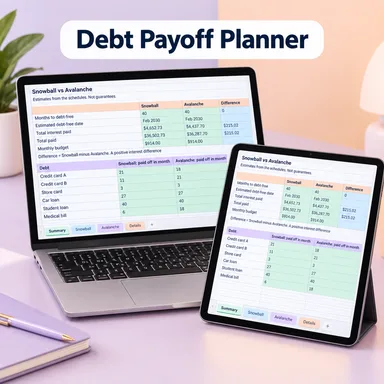
Bucket Budget Planner includes a Debt Payoff Planner that does it. You enter up to 15 debts with their balance, APR and minimum payment, plus an extra monthly payment. The Compare tab shows, for snowball and avalanche, the months to debt-free, the estimated debt-free date, the total interest and the total paid, with the difference between them and a balance chart. Month-by-month schedules for each method are on separate tabs. The planner labels the results as estimates, not guarantees. Because the same file is included with the main budget planner, you can find your extra payment in your own bucket budget.
If your budget is a mess at the moment, a reset might come first. The budget reset checklist walks through listing bills and debts in about 90 minutes.
This guide is general information, not financial advice. It does not recommend either method for your situation.