No-Spend Month Challenge: How It Works and How to Do It
A no-spend challenge is a period, usually 30 days, when you pay for essentials only and pause everything else. It is less about saving a specific amount than about interrupting autopilot spending so you can see what you actually miss. Here is how to set it up, with rules, tracking and what to do afterward.
Why people try it
- To reset habits such as daily coffee runs, impulse online orders or takeout.
- To find money for a goal, such as an emergency fund or a trip.
- To see how much of their spending is necessary and how much is habit.
- To recover after a heavy spending period such as the holidays.
Step 1: Pick the format
| Format | Length | Good for |
|---|---|---|
| Weekend no-spend | 2 or 3 days | A first try or a weekly reset |
| Week | 7 days | Testing your rules |
| 30-day challenge | One month | Real habit change |
| No-spend category | A month, one category | Cutting a specific habit |
If you have never done one, start with a weekend or a week.
Step 2: Write the rules down
Rules prevent arguments with yourself on day 12. Write them before you start.
Usually allowed:
- housing, utilities, insurance
- minimum debt payments
- basic groceries, with a set weekly amount
- transportation needed for work
- medicine and health needs
- pet food and necessary childcare
Usually paused:
- dining out and takeout
- entertainment and subscriptions you can pause
- clothing, decor and gadgets
- impulse online purchases
- non-essential gifts
Gray areas: decide ahead of time. Examples include birthday gifts, a haircut or a replacement for something that broke. Many people use a rule such as "if I can wait until the challenge ends, it waits".
Step 3: Prepare
- Check your pantry and freezer, and plan meals around what you have.
- Unsubscribe from store emails and remove saved payment details from shopping apps.
- Pause or cancel subscriptions you do not use. Keep a list of what you cancel.
- Tell the people you live with and agree on shared rules.
- Choose what the money you keep will do: savings, debt or a goal.
Step 4: Track it daily
A check-off calendar is enough. For each day, record whether you spent only on essentials, and note urges, swaps and anything you bought. A running streak makes the progress visible. At the end, compare the month with your usual spending. If you track your spending normally, you already have the baseline; see how to track spending.
Swap ideas
When the urge appears, replace the purchase rather than only resisting it:
- Coffee shop → coffee at home in a nice cup
- Takeout → a freezer meal you prepared
- New book → library hold
- Streaming rental → something already in your list
- Shopping as a mood lift → a walk, a call or a hobby you already own supplies for
When you slip
You will probably slip. Write down what happened, what triggered it, and whether the rule needs changing. Then continue the next day. A challenge with one exception is still a month of far fewer purchases.
After the challenge
The end is the most important part. Without a plan, spending can bounce back.
- Total what you saved compared with a normal month.
- Send that money to its purpose right away.
- Decide which paused items you want to keep paused.
- Keep one weekly no-spend day or weekend.
- Add to your budget any cut that you did not miss.
If you want to turn what you learned into a lasting plan, read how to stick to a budget. The challenge also pairs well with the season after the holidays; see how much to spend on Christmas gifts.
The tracker in Clear Budget Planner
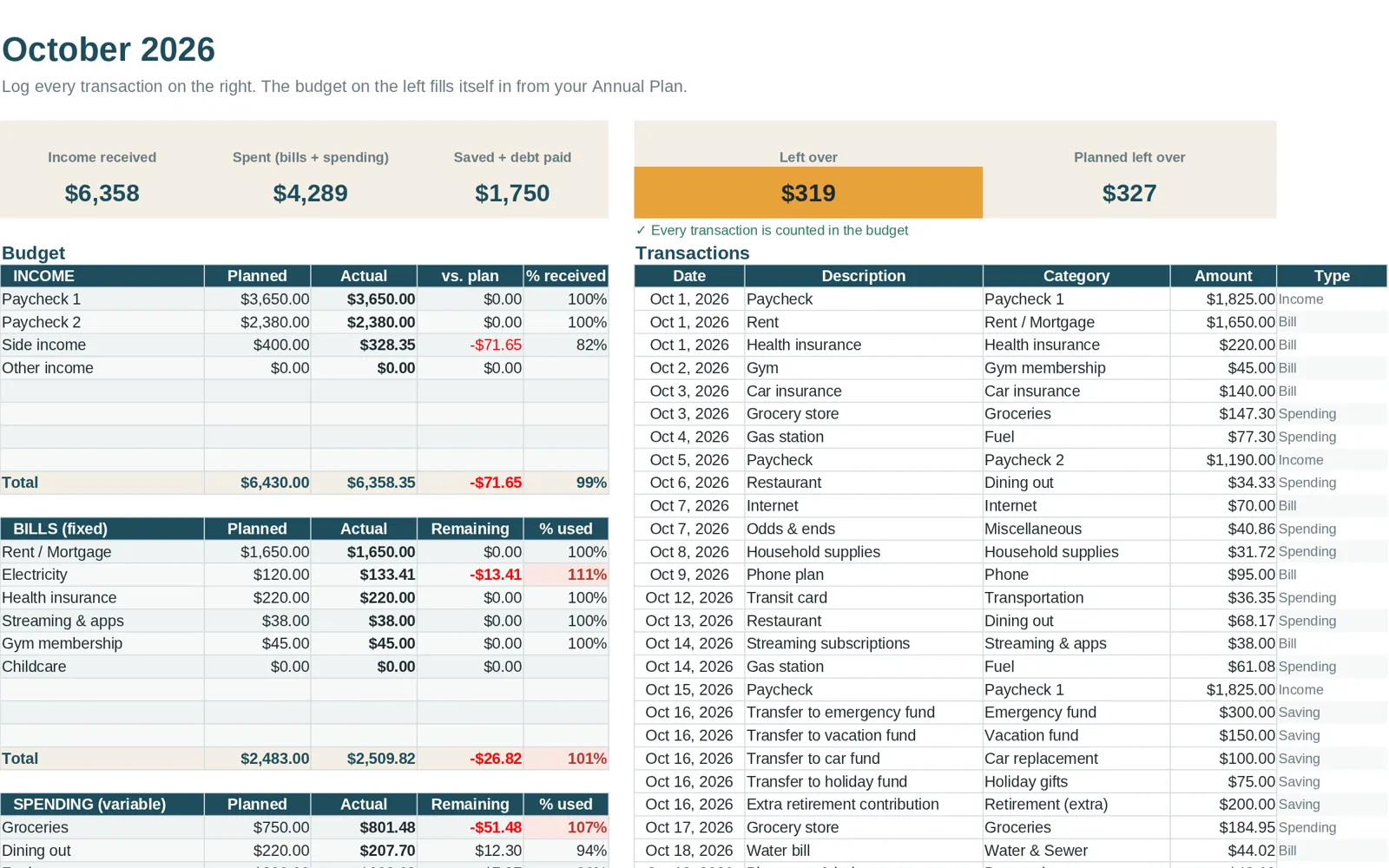
Among the bonuses delivered with Clear Budget Planner is a No-Spend Challenge Tracker, a spreadsheet for a 30-day or weekend challenge with your own rules, a check-off calendar, a streak and a comparison of money kept versus your usual spending. It unlocks in your member area after purchase. The main planner itself is an annual budget workbook with twelve monthly tabs, a Dashboard, Year Summary, Savings Goals and more, so you can see what the challenge month did for the year.
It is a spreadsheet for organizing your own numbers, not financial advice.