52 Week Savings Challenge: How It Works and Which Version to Pick
The 52 week savings challenge is a plan in which you set aside a small amount each week and let the amounts follow a pattern for a full year. In the classic version, you save 1 in the first week, 2 in the second, 3 in the third, and so on up to 52. Over a year, the deposits total 1,378. This guide explains the math, four ways to run it and how to make it fit your budget.
The classic version
| Week | Deposit |
|---|---|
| 1 | 1 |
| 2 | 2 |
| 3 | 3 |
| ... | ... |
| 26 | 26 |
| ... | ... |
| 51 | 51 |
| 52 | 52 |
| Total | 1,378 |
The total comes from adding the numbers from 1 to 52, which is 52 × 53 ÷ 2 = 1,378. The weeks are small at the start, so it feels easy. The difficulty is in the second half: by week 40 you are setting aside 40 that week, and the last few weeks are the biggest.
If you use a different step, the total scales. A step of 2 means deposits of 2, 4, 6 and so on, and the total is 2,756.
Four ways to run it
1. Classic (smallest to largest)
Deposits rise from the step amount to 52 times the step. It is gentle at the beginning and heavier at the end. It suits you if you like starting small to build the habit.
2. Reverse (largest to smallest)
You start with 52 in week 1 and decrease to 1 in week 52. The total is the same, but the hardest weeks come first, when you are most motivated, and the last weeks are easy. It also puts the money in the account sooner, in case you stop early.
3. Fixed weekly amount
The same deposit every week. At 25 per week, 52 weeks total 1,300. It is the easiest to remember and to fit in a budget, since every week looks alike.
4. Biweekly (one deposit per paycheck)
If you are paid every two weeks, make 26 deposits instead of 52. In a typical version, the first paycheck sets aside 1 step, the second 2 steps, up to the 26th paycheck at 26 steps. With a step of 5, the total is 5 × (26 × 27 ÷ 2) = 1,755. It matches the way your money arrives, so you do not have to make a deposit between paychecks.
Which version should you pick?
| If you... | You might prefer |
|---|---|
| Like to start small and build momentum | Classic |
| Worry about losing steam later in the year | Reverse |
| Want a simple, predictable number | Fixed weekly |
| Are paid every two weeks | Biweekly |
| Have big expenses in December | Reverse, or classic starting in a different month |
You can also change the step or start date. The goal is a plan you can keep, not a particular total.
Check your budget first
Before starting, find where the money will come from. The late-year deposits of the classic plan can be large. A simple way:
- List your bills and goals and convert them to weekly or per-paycheck amounts. The method is in what is bucket budgeting.
- See what is left after the buckets are funded.
- Choose the version and step that fit inside it.
If the challenge does not fit, shrink the step. A smaller plan that you finish is better than a larger plan you abandon.
What to save for
A challenge works better with a purpose. Common choices:
- A starter emergency cushion
- A holiday or gift fund
- A trip
- A large annual bill, as described in what are sinking funds
- A down payment or other long-term goal
Giving the money a name helps you resist spending it.
Tips for staying on track
- Automate when you can. A scheduled transfer to a separate account removes decisions.
- Use a visible tracker. Marking each week as done is surprisingly motivating.
- Plan for a short week. If a week is too tight, make up the amount later.
- Keep the money apart. A separate account or labeled sub-account makes it harder to spend by accident.
- Review at the halfway point. Check whether the second half is realistic and adjust the step if needed.
Things to consider
- The challenge is a habit tool, not an investment plan. It does not create a particular result for everyone.
- The late classic weeks are large, so the plan might not suit you if your income varies a lot.
- Savings goals depend on your situation, and you may prefer to pay down high-interest debt first. See the budget reset checklist for a way to review your accounts and debts.
Using a ready-made tracker
Bucket Budget Planner includes a 52-Week Savings Challenge in Excel with all four versions: Classic, Reverse, Fixed and Biweekly. On the Dashboard you set a start date and the step or weekly amount. Each plan has its own tab with the week or paycheck number, the date, the deposit, a Done? column where you type Yes, the running total saved and a progress mark. The Dashboard shows, for every plan, the number of deposits, the plan total, how many are done, how much you have saved so far and how much is left to go. The defaults are a step of 1 for classic and reverse, a fixed amount of 25 and a biweekly step of 5, and all of them can be changed.
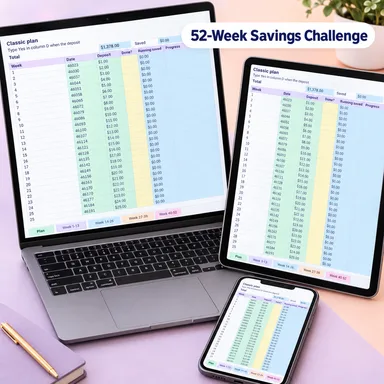
The challenge file comes with the main budget planner, so you can check that the deposits fit in your buckets. The included web app also has a Savings Goal Tracker. For the monthly habit of comparing plans with spending, see the monthly spending tracker guide.
This guide is general information, not financial advice. A savings challenge does not guarantee any particular amount saved.