Low Income Budget: How to Plan When Money Is Tight
A low income budget follows one rule: cover the things you cannot skip first, plan on the lowest month, and give every remaining dollar a job. The same approach works when your income is irregular rather than low. This guide shows a practical way to do it, without promises about how much you will save.
Start with what is true right now
A budget is only useful if it matches your actual numbers. Start with three lists:
- Money coming in. Every source, with a usual amount and the amount from a lean month.
- Must-pay bills. Housing, utilities, food, transportation to work, insurance, minimum debt payments, essential medications.
- Everything else. Subscriptions, eating out, entertainment, gifts, savings.
If your income varies, look back at the last three to six months and find the lowest month. That is the number to plan on. If you have no history, use a cautious guess and adjust after a month or two.
Plan on the low month
When income varies, planning on the average is risky: a month below average will not cover a budget built for an average. Planning on the low month has a clear advantage. In a better month you will have more than the plan needs, and you decide in advance what to do with the extra.
A simple structure:
- Baseline budget: built on the low month. It pays the must-pay bills and a small amount to savings and spending.
- Extra income rules: a short list that says what any additional money does, such as: first, build a small cushion; second, fund an annual bill; third, put some toward a goal or a treat.
Writing the rules down before the money arrives makes them easier to follow.
Tier your spending
Dividing spending into tiers makes tight months less stressful:
| Tier | Examples | In a lean month |
|---|---|---|
| Must pay | Housing, utilities, food, transport to work, insurance, minimum debt payments | Always funded first |
| Should pay | Phone upgrades, regular savings, extra debt payments | Reduced if needed |
| Nice to have | Dining out, subscriptions, hobbies | Paused or cut first |
You can set the tiers once and then use them every month to decide what to trim.
Use buckets so you can see the trade-offs
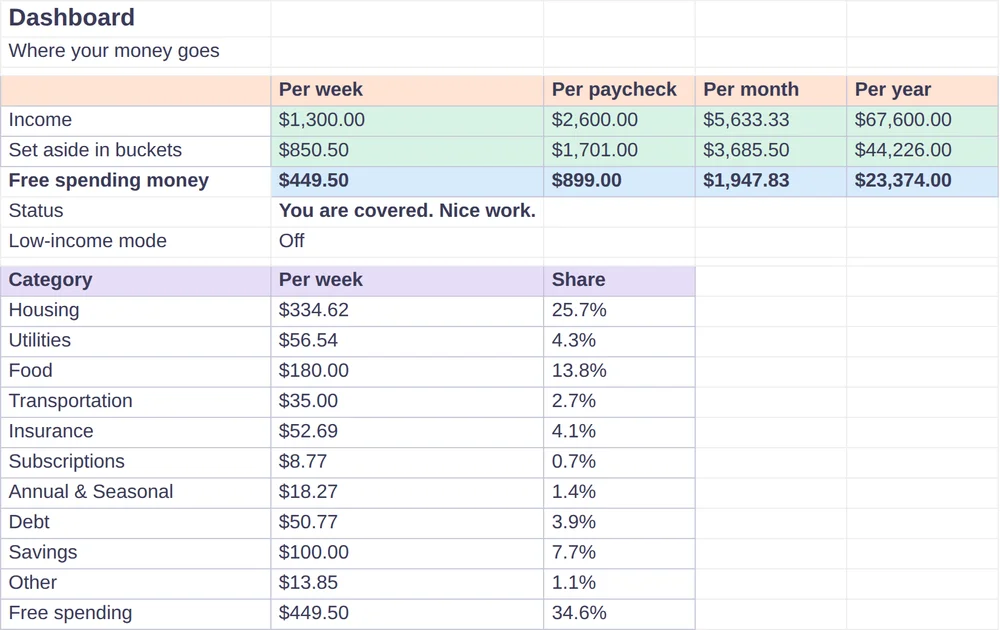
Instead of one long list of expenses, group your money into buckets: housing, food, transportation, bills, debt, savings, fun. Every bucket gets a weekly or per-paycheck amount. When money is tight, buckets let you see exactly how much each one takes and what happens if you shrink another. The idea is covered in more detail in what is bucket budgeting.
If you need ideas for what belongs in each bucket, see the budget categories list.
Make irregular bills predictable
A common problem on a tight budget is the bill that arrives once or twice a year. A car registration or an insurance premium can wipe out a month. The remedy is to split it into small amounts across your paychecks well before it is due. Even a small weekly amount in a dedicated bucket makes the bill less of a shock. The method is described in what are sinking funds.
Track what really happens
Plan numbers are guesses until you compare them with real spending. Once a month, write down what you actually spent in each bucket and compare it with the plan. You are looking for patterns, not for blame: which bucket runs over, and is the plan wrong or the spending? A monthly check takes about ten minutes and gives you better numbers for next month. For a simple routine, see the monthly spending tracker guide.
A mini example
Suppose someone has two sources of income: a main job paying 1,800 in a lean month and 2,100 in a typical one, and a side gig paying between 100 and 250. Planning on 1,900 (the lean month for each source added together) might look like this:
| Bucket | Monthly plan |
|---|---|
| Housing | 800 |
| Utilities and phone | 200 |
| Food | 350 |
| Transportation | 180 |
| Insurance | 100 |
| Minimum debt payments | 90 |
| Annual and seasonal costs | 60 |
| Spending money | 70 |
| Savings | 50 |
| Total | 1,900 |
The numbers are made up. The point is that the plan balances at the low amount, so any extra income is a choice rather than a gap being filled.
Using a spreadsheet for variable income
Bucket Budget Planner has a setting for this situation. On the Setup tab, each income source gets a usual amount and a low month amount, along with how often it arrives. A Low-income mode switch then lets you see the budget based on the lean figures. The Buckets tab converts each bill or goal into a per-week, per-paycheck, per-month and per-year amount, and the Dashboard shows whether your income covers your buckets or whether you are over budget. The included Budget Reset Checklist is a printable PDF that walks you through listing your bills and sorting them into buckets.
No spreadsheet can change what you earn. It can help you see your numbers clearly and make the choices that are yours to make.
When the numbers do not work
If the must-pay bills alone exceed your income, a budget will show the gap but cannot close it by itself. Options worth exploring include talking to creditors or your landlord before you miss a payment, asking a nonprofit credit counseling agency to review your situation, and looking into local assistance programs. In the United States, calling 211 is one way to find them. Availability depends on where you live.
A short checklist
- List your income sources with a low month amount.
- List must-pay bills first.
- Build the budget on the low amount.
- Write down what extra income will do.
- Put yearly bills into small regular amounts.
- Check your spending once a month and adjust.
For a printable version of this process, see the budget reset checklist. For the general method of budgeting each paycheck, see how to budget a paycheck.
This guide is general information, not financial advice. It does not promise any particular savings or outcome.